








2026-06-09 · Baduno Editorial Team · 27 Min. reading time · Blog & Knowledge
Website Localization for Sweden: Minimalism Meets Purchasing Power
Sweden isn’t just Scandinavian – it’s a market of its own, with high purchasing power and a specific aesthetic. To succeed here, you need to understand lagom, offer invoice-based payment, and communicate sustainability credibly. Our guide shows how to localize your website for Sweden – from design and legal to SEO.

Why Sweden is its own localization market
Sweden differs in many ways from other European markets – not only linguistically, but also culturally and economically. With one of the highest internet penetration rates in Europe (over 95%) and strong per capita purchasing power (around USD 44,000 GDP per capita, source: World Bank 2023), Sweden is an attractive yet demanding market. Those who want to succeed here cannot avoid deep localization: pure website translation is generally not enough to generate relevant sales.
Swedish consumers expect a shopping experience tailored to their specific needs. This includes a clear, minimalist aesthetic in the style of 'Lagom' (the principle of moderation), reliable payment processing via invoice (often in cooperation with Klarna), and a high degree of transparency regarding sustainability. The Swedish soul values efficiency and functionality, but also social responsibility. Websites that come with superimposed, non-localized content are quickly branded as 'inauthentic'.
Another aspect is the tone of communication: While countries like Germany or France often prefer formal address with 'Sie', Sweden is known for its informal yet professional style. 'Du' is the norm – even in official business contacts. However, that does not mean politeness can be ignored. Too casual or intrusive language quickly appears unprofessional. The key lies in friendly, direct, and respectful communication that puts the user at the center.
Practical recommendation: Before launching a localized website for Sweden, a thorough analysis of local competitors and cultural codes should be conducted. Integrate Swedish payment providers (especially Klarna) and ensure your design language matches the minimalist ideal. Test the site with a local user group to avoid any cultural missteps. Only then does a simple translation become genuine localization that fosters trust and revenue.
The Lagom Aesthetic in Design and User Experience
"Lagom" – a Swedish word that means "not too little, not too much, just right" – is the defining design principle in Sweden. It is reflected in architecture, interior design, and also in web design. For website localization, this means: less is more. Cluttered, playful, or flashy interfaces are often perceived as unpleasant or unprofessional in Sweden. Instead, users expect clean lines, plenty of white space, and a information architecture reduced to the essentials.
In practice, this means for your website: opt for a subtle color palette favoring natural tones and pastels. Product design should take center stage – no distracting banners or pop-ups that divert users from what matters. Navigation is intuitive and minimalist, often with a clear hierarchy that guides users directly to their goal. "Lagom" also implies that loading times should be short, texts concise, and calls-to-action clear but not intrusive. A typical Swedish online store displays products in calm, high-quality images, often in a natural context (e.g., furniture in a furnished room with daylight).
Another aspect is user experience (UX): Swedes are accustomed to websites that work quickly and reliably. Functionality takes precedence over aesthetics, but ideally both combine. Mobile optimization is non-negotiable, as a large share of online shopping occurs via smartphones. Ensure consistent design elements that convey the Lagom mindset – this builds trust and reduces bounce rates.
Concrete recommendation: Review your design for "Lagom suitability." Eliminate superfluous elements, use a soft color scheme (no garish colors), and invest in high-quality imagery. Test the user journey with Swedish test subjects to ensure the page is not perceived as cluttered or too lifeless. When in doubt: less is more – but not less than necessary.

Invoice Purchase as Payment Standard: Klarna & Co.
Payment methods are a critical factor for success in Swedish e-commerce. While credit cards or PayPal dominate in many countries, invoice purchase ("faktura") is by far the most popular payment method in Sweden. Market leader is Klarna, a Swedish fintech company that already serves over 90 million customers worldwide. In Sweden itself, Klarna is nearly ubiquitous – according to experience, over 60% of online shoppers use this option. The reason: Swedes value the security and flexibility of being able to inspect goods after receipt before paying.
Integrating Klarna into your localized website is therefore not an optional extra but a basic requirement to be competitive in Sweden. Customers who do not find their preferred payment method typically abandon the purchase process. In addition to Klarna, there are other local providers such as Swish (a mobile payment app widely used by Swedes in everyday life) or traditional bank transfers. However, Klarna due to its popularity and ease of integration is often the first choice.
Important: Payment processing should be seamless and straightforward. Swedish users expect a fast checkout where they can pay via invoice, installment plan, or immediate transfer. Transparency is also required: costs for the payment service (e.g., for installment payments) must be clearly communicated to maintain trust. Another plus is the ability to change the payment method during the ordering process without re-entering data.
Recommendation: Integrate Klarna as the primary payment method and optionally Swish for mobile users. Thoroughly test the checkout flow – it must be fast, clear, and error-free. Ensure that all legal requirements (e.g., terms and conditions, right of withdrawal) are formulated in Swedish and in accordance with Swedish law. Have the localization of payment pages reviewed by a native-speaking expert to avoid cultural nuances and legal pitfalls. Note: Legal advice from a specialist in Swedish contract law is essential here.
Sustainability Expectations: From Fairchain to CO2 Compensation
Swedish consumers place great importance on sustainability – that's no secret. But for your website localization, this means more than just adding a green logo. What is expected is a credible and transparent presentation of your ecological and social responsibility. Start by disclosing your supply chain: Where are your products manufactured? Under what conditions? Keywords like "Fairchain" or "ethical production" are not empty promises in Sweden but concrete requirements. Show certificates if available, or explain your own efforts in simple, understandable language.
A central point is CO2 compensation. Swedes are environmentally conscious and expect companies to reduce their footprint or at least offset it. Provide clear information on your website about compensation projects, ideally with links to independent verification bodies. Avoid vague phrasing like "we plant trees"; specify how many trees, where, and with what certification. Product lifespan and repairability are also relevant – highlight if your products are durable or recyclable.
Practically speaking, we recommend creating a dedicated "Sustainability" subpage that is regularly updated. Use concrete examples from your company, such as reducing packaging materials or using renewable energy. Ensure that all sustainability claims are verifiable – exaggerated statements can quickly be perceived as greenwashing and harm your credibility. In practice, it has proven beneficial to publish a sustainability report according to international standards (e.g., GRI), even if it is brief.
Remember: Sustainability is a competitive factor in Sweden. Customers compare offerings not only by price but also by ecological footprint. Therefore, integrate sustainability aspects into your product descriptions, for example by specifying the CO2 footprint per item. A note on environmentally friendly shipping options (e.g., carbon-neutral shipping) rounds off the picture. Above all: Be honest and avoid exaggerations – Swedish consumers recognize authenticity immediately.
Du or Sie? The Swedish Tone in Texts
The form of address in Sweden is one of the first cultural hurdles in website localization. Unlike Germany, where the formal "Sie" predominates, in Sweden the informal "du" is common in both private and business contexts. This informal culture reflects the Swedish ideology of equality: hierarchies are kept flat, and distance is avoided. For your online shop or website, this means: Use "du" consistently in all texts, from product descriptions to terms and conditions. A formal "Sie" ("ni") quickly comes across as stiff, old-fashioned, or even condescending.
At the same time, "du" should not be mistaken for carelessness. The tone should remain professional and respectful, but without formal barriers. Write actively and directly: "Click here to activate your account" instead of "You can click here." Even in emails and customer service, "du" is standard. Best test your texts with native Swedish speakers to ensure the tone does not come across as too flippant or disrespectful. In practice, a mix of friendliness and objectivity has proven well-received.
Caution with special cases: In very traditional sectors (e.g., law firms or luxury goods), "Sie" may still be used occasionally, but even there the trend is toward "du." When in doubt, orient yourself on large Swedish e-commerce platforms – almost all use "du." Definitely avoid inconsistent address, i.e., switching between "du" and "Sie" within one page. That appears unprofessional and confuses the reader.
Another aspect is gender neutrality: Sweden is very progressive in equality. Use gender-neutral formulations, e.g., "kund" (customer) instead of "buyer" or "user." Avoid generalizations like "the customer" – instead use paraphrases or the generic feminine (e.g., "die Kundin"). Overall: The tone should be welcoming, personal, and yet professional. A friendly "du" builds trust without undermining the seriousness of your brand.
Legal Pitfalls: Data Protection, Terms and Conditions, and Imprint
As an EU member, Sweden has implemented the GDPR, but there are national specifics you must consider when localizing your website. The Swedish Data Protection Act (Dataskyddsförordningen) supplements the GDPR with specific requirements, such as consent for cookies. Your privacy policy must be available in Swedish and clearly state what data is processed for what purpose. Ensure that cookie banners not only inform but also require active consent (opt-in) – this is stricter in Sweden than in some other countries.
Regarding General Terms and Conditions (GTC), it‘s not just about translation but adaptation to Swedish law. In particular, the right of withdrawal is precisely regulated: consumers have a 14-day right of cancellation, and you must provide clear instructions for returning goods. Warranty (reklamation) is also different from Germany: Sweden has a three-year limitation period for defects, unless otherwise agreed. Have your GTC reviewed by a Swedish lawyer to avoid liability traps.
The imprint (“Uppgifter om webbplatsens utgivare”) is also mandatory in Sweden, but the requirements are somewhat different. In addition to company name and address, you must provide an email address – a phone number is not mandatory but recommended. Commercial register entry and VAT ID (“organisationsnummer” and “momsregistreringsnummer”) are also required. Ensure the information is easy to find, usually in the footer or on a separate “Contact” page.
Practically, we recommend setting up a separate legal database for Sweden and regularly checking for updates, e.g., via the Svensk Handel association. Also note the Swedish Marketing Act (Marknadsföringslagen), which has strict rules against misleading advertising. This also applies to sustainability claims – they must be substantiated. For comprehensive advice, consult a law firm specializing in international business law. This is the only way to ensure your localized website is legally compliant and avoid warnings.

Swedish SEO: Search Behavior and Keyword Research
Search engine optimization for Sweden differs fundamentally from other markets. In practice, it turns out that Swedes predominantly use Google, but Bing also has a relevant market share of about 10 percent. Search queries are often longer and more precisely formulated—users often enter complete questions like 'Var kan jag köpa ekologisk honung i Stockholm?' This means for your keyword research: focus on long-tail keywords and semantic search terms. Simply translating German keywords rarely achieves the goal; instead, you should work with native speakers who understand local search habits. Typical examples: instead of 'günstige Möbel,' Swedes search for 'billiga möbler' or 'möbler till bra pris.' Also consider seasonal trends, such as 'julklapp' starting in November or 'sommarrea' in July.
For keyword research, it is recommended to use the Google Ads Keyword Planner with Sweden as the location and compare search volumes with local competitors. Experience shows that product categories with clear search intent like 'köpa löparskor' are easier to plan than generic terms. A common mistake is neglecting compound word formation in Swedish: for example, 'Energieberater' becomes 'energirådgivare,' not written separately. Also pay attention to regional differences—search terms in Stockholm may differ from those in Gothenburg. Use tools like Ahrefs or Sistrix with a Swedish index, but do not blindly trust data; manual review by a localization specialist is essential.
Concrete action recommendation: Create a list of 20–30 relevant keywords, have them checked by a Swedish native speaker for correctness and search intent, and then integrate them into your URL structure, meta tags, and headings. Ensure that your page content answers users' questions—Swedes expect clear, informative texts. Avoid keyword stuffing; Google recognizes and penalizes it. Test the visibility of your pages using a local proxy and adjust the strategy regularly. Remember: SEO is a long-term process; do not expect immediate results.
Cultural Nuances: Symbols, Colors, and Visual Language
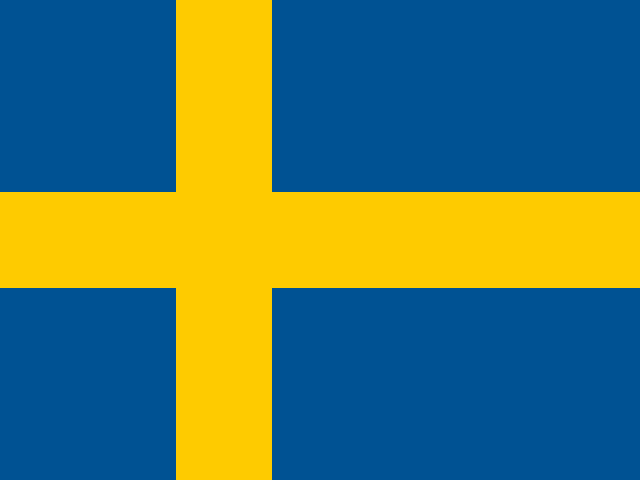
Visual communication in Sweden follows its own rules. Swedes appreciate clarity and restraint – the "Lagom" principle (just the right amount) is reflected in colors and images. Prefer a reduced color palette: blue and yellow as national colors can be used subtly but quickly feel clichéd. Pastel tones, muted green, or gray that evoke Swedish nature are more suitable. Avoid aggressive signal colors like bright red or orange; they are perceived as intrusive. In imagery, the focus is on naturalness: people in everyday situations, often outdoors or in simple interiors. A picture of a family having a picnic in the forest works better than a staged advertising image. Important: ensure authenticity – Swedes immediately recognize unnatural staging.
Symbols should be chosen with care. The Swedish "Fika" concept (coffee break with pastries) is a good way to convey coziness. The moose figure is also often used, but don't overdo it – it can be seen as too clunky. Instead, use subtle cultural references, such as a Dala Horse as a small detail. Avoid symbols that are negatively charged in Sweden, such as excessive displays of national pride. In practice, images of people in casual clothing and natural light have been shown to work best. Photograph locally or use local stock photo platforms like "Stocksy" with Swedish motifs. Another tip: integrate seasonal elements like Midsummer flowers or candlelight during Advent to create emotional closeness.
Concrete action recommendation: Have your image selection reviewed by a Swedish designer or localization expert. Test different variants in a small user group – for example, via social media. Ensure your images do not break any taboos: avoid political or religious symbols unless they are part of the product. Also adapt the representation of numbers and data: Swedes use the metric system and 24-hour time. A culturally adapted design builds trust and increases time spent on your site.
Practical Translation Work: Jargon, Filler Words, and Anglicisms
Translation for the Swedish market requires a feel for linguistic nuances. Swedes prefer clear, understandable language without unnecessary frills. Avoid technical jargon unless it is industry standard – even then, explain complex terms. Filler words like "liksom" (so to speak), "typ" (kind of), or "ba" (just) belong in spoken language, not in professional web texts. In writing, they come across as unprofessional and weaken credibility. A common mistake is adopting English phrases. Anglicisms are widespread in Swedish, but you should check whether a suitable Swedish equivalent exists. For example, "performance" can often be replaced by "prestanda," "support" by "kundtjänst." Pure "English with Swedish endings" (e.g., "performancer") seems lazy and can be viewed negatively.
Addressing the reader is another stumbling block: Online, the informal "du" is standard, but in some industries (banks, insurance), the formal "ni" may be appropriate. When in doubt, use "du" and remain consistent. Avoid imperative sentences at the beginning; Swedes respond better to polite requests like "Vill du veta mer?" Humor is also tricky – it should be subtle and situational. A friendly but direct approach has proven effective. Pay attention to text length: Swedish sentences are often shorter than German ones. Do not translate word for word; adjust sentence structures. Example: "Wir bieten Ihnen eine umfassende Beratung an" becomes "Vi erbjuder dig en grundlig rådgivning" – that sounds more natural.
Concrete action recommendation: Create a style guide for your Swedish texts that includes clear rules on Anglicisms, filler words, and tone of voice. Have translations proofread by a native speaker who is not the translator. Test the texts with Swedish users in an A/B test on your website. Also consider regional variations – what is common in Stockholm may sound different in Malmö. Avoid generic phrases like "We are the leading provider"; Swedes expect evidence rather than claims. A good test: read the text out loud – if it doesn't sound natural, revise it. Remember: good localization is invisible – it only stands out when it's missing.
Sweden isn’t just Scandinavian – it’s a market of its own, with high purchasing power and a specific aesthetic. To succeed here, you need to understand lagom, offer invoice-based payment, and communicate sustainability credibly. Our guide shows how to localize your website for Sweden – from design and legal to SEO.
Testing Localization: Proofreading and Usability Review
Before launching your localized website for Sweden, thorough quality assurance is essential. This covers two key areas: linguistic editing and usability testing with Swedish users. For the editing, ideally engage a native-speaker proofreader who checks not only grammar and spelling but also cultural nuances and the correct tone (du vs. ni, Lagom principles). Ensure that specialized terms like "Faktura" (invoice) or "Miljö" (environment) are used correctly and that anglicisms are minimized.
Usability testing should be carried out with real Swedish users, ideally in a moderated test. Have participants perform typical tasks: create an account, add an item to the cart, and go through the checkout process. Pay special attention to the invoice purchase option (e.g., Klarna) – it must be offered clearly and without confusion. Note all points where users hesitate or abandon. Additionally, you can run an A/B test to validate color and image choices – in Sweden, subtle natural tones and realistic product photos are usually preferred.
Recommendation: Use tools like UserTesting or local agencies to recruit Swedish testers. After the editing, also conduct a final legal review to ensure that the terms and conditions and privacy policy comply with Swedish regulations (e.g., Datainspektionen). Plan at least two iterations to fix identified issues. Record all changes in a localization changelog to facilitate later updates.
In practice, it has proven effective to review text and design changes in parallel – because the linguistic impact often depends on the visual embedding. Example: an overly intrusive call-to-action button in bright red can come across negatively to Swedish users. Ask your testers for concrete feedback, and don't hesitate to change even seemingly small details. Only then can you ensure your website is not just translated but truly localized.

Technical Implementation: hreflang, Currency, and Country Subdomain
The technical implementation of your Swedish localization is critical for discoverability and user experience. Three key aspects need attention: correct implementation of hreflang tags, display of SEK currency, and choice of URL structure. For hreflang, use the code "sv-SE" for Sweden. Ensure that each language version receives a corresponding tag to avoid duplicate content issues. Example: <link rel="alternate" hreflang="sv-SE" href="https://example.se/" />. At the same time, you also need to specify the default version (e.g., "de-DE") and a generic fallback ("x-default").
For currency, SEK (Swedish krona) is mandatory. Adjust prices not only by conversion but also consider market-specific pricing – in Sweden, round prices are common (e.g., 499 SEK instead of 495 SEK). Display should use the currency symbol "kr", though variants like "SEK" are also accepted. Integrate prices dynamically into your shop software and test that the conversion is based on the current exchange rate. Plan for regular updates to avoid losses.
The choice of URL structure has SEO implications. For Sweden, we recommend a country subdomain (e.g., se.example.com) or the .se top-level domain (e.g., example.se). A subdomain with country code facilitates geographic targeting and is preferred by Google. Avoid subfolders like example.com/sv/, unless you use additional countries. Also set up a redirect so that users from Sweden are automatically directed to the correct version – based on IP or language setting. Consider loading times: hosting in Sweden or using a CDN can improve performance.
Concrete action recommendation: Review your existing URL structure and choose the appropriate method. Implement hreflang tags via .htaccess file or a CMS plugin. Test correct output using Google Search Console – there you can verify whether your tags are correct. For prices: use a plugin or custom script that sets regional prices, and ensure the currency is consistent throughout the checkout. Conduct a sample check on different devices to rule out display errors.
Checklist: 10 Points for the Sweden Launch
To ensure a smooth market entry into Sweden, we have compiled a 10-point checklist. Go through it point by point before launch.
1. Linguistic quality: Proofreading the entire website by a native Swedish speaker. Use Lagom phrasing – balanced and unexaggerated – and avoid overly promotional language. 2. Payment methods: Integrate Klarna (invoice purchase) and optionally Swish. Place these options prominently in the checkout. 3. Legal compliance: Privacy policy, terms and conditions, and imprint in accordance with Swedish law (Personal Data Act, Swedish Data Protection Authority). Have these reviewed by a Swedish lawyer. 4. Currency and prices: Ensure all prices are displayed in SEK and conversions are correct. Avoid cent amounts; round to whole 10 or 100 SEK. 5. Shipping and delivery: Offer shipping options for Sweden (e.g., PostNord, DHL). Clearly communicate delivery times and costs. 6. Customer service: Provide Swedish support (email/phone) in the Swedish language, ideally with local business hours. 7. Technical SEO: Implement hreflang tags (sv-SE), a suitable URL structure (subdomain se.example.com or .se domain), and submit the sitemap to Google. 8. Cultural adaptation: Check images, colors, and symbols for cultural suitability. Use naturalistic motifs without clichés. 9. Mobile optimization: Sweden has high smartphone usage. Test the website on all common devices and ensure fast loading times. 10. Test run: Conduct a beta test with real Swedish users. Have them go through the entire purchase process and collect feedback.
Supplement this list with your company-specific requirements. Note responsibilities and deadlines. A successful launch in Sweden is based on thorough preparation – take the necessary time to work through the checklist. After launch, conduct regular analyses (e.g., conversion rate, bounce rate) to make adjustments. Note that legal requirements may vary by industry – consult a legal advisor if needed.
Success measurement: Metrics and adjustments after go-live
After the launch of the localized website, the critical phase begins: success measurement. Define measurable goals in Google Analytics or another tool in advance – for example, increasing the conversion rate by a certain percentage or reducing the bounce rate. In practice, a monthly rhythm for analysis has proven effective. Create specific segments for Swedish traffic to highlight cultural differences. Pay attention to metrics such as average order value, page views per visit, and time spent on product pages. A sudden drop in conversion rate may indicate issues in the checkout – then test alternative payment processes or text versions.
Alongside quantitative data, qualitative methods such as heatmaps or session recordings provide valuable insights. Observe whether Swedish users scroll differently or click on certain elements more frequently. Supplement this with short surveys or feedback buttons on the page. If, for example, the click-through rate on the 'Add to cart' button is low, check its placement and label – in Sweden, clear, action-oriented language (e.g., 'Lägg i varukorgen') is often more effective. Adjust the page iteratively based on the collected data. Conduct A/B tests for critical elements such as product images, call-to-action texts, or button colors. Document every change and its impact.
Another important indicator is organic traffic from Sweden. Compare the visibility development for your relevant keywords using tools like Google Search Console. A decline may indicate technical issues – such as incorrect hreflang tags or loading times. In practice, monthly reports with key KPIs help justify the budget for further localization efforts. Don't hesitate to revert an experiment if data is negative. Continuous optimization based on real user data is the key to sustainable success. Note that data protection regulations (e.g., GDPR) may restrict the collection of personal data – seek legal advice on this.
Outlook: Trends such as voice control and mobile-first in Sweden
The digital landscape in Sweden is evolving rapidly, and two trends are gaining particular importance: voice control and mobile-first. A significant portion of the Swedish population already uses voice assistants like Google Assistant or Apple's Siri for everyday searches. For your localized website, this means you should optimize content for voice search. Instead of short keywords, whole questions and natural language patterns are needed – for example, "Var kan jag köpa ekologisk hudkräm?" instead of just "ekologisk hudkräm". In practice, it is advisable to create a list of frequently asked questions about your product or service and integrate them as FAQ or in long-content formats. Pay attention to featured snippets, as voice assistants often read these answers aloud.
At the same time, the Swedish market is heavily mobile-oriented: over 80% of internet users access websites via smartphone. A mobile-optimized presence is therefore not an optional extra but a basic requirement. Test your website with tools like PageSpeed Insights to check loading speed on mobile devices. In practice, Progressive Web Apps (PWAs) have proven effective, as they offer fast loading times and an app-like user experience without needing a download from the app store. Implementing Accelerated Mobile Pages (AMP) can also be useful for certain content such as blog articles to improve visibility in mobile search results.
Furthermore, personalization is gaining importance: Swedish users increasingly expect tailored content, offers, and product recommendations based on their previous behavior. Use data protection-compliant solutions here, such as analyzing browsing behavior with anonymized data. The trend towards sustainable e-commerce will also remain: ensure that your mobile pages make environmental information clear and quickly accessible. For the future, you should also keep an eye on Augmented Reality (AR) – for example, for virtual try-ons of clothing or furniture. Investing in these technologies can position your brand as innovative, but requires careful planning and testing. Observe the legal framework for new technologies and, if in doubt, seek professional advice.
Pitfalls and common mistakes in Sweden localization
Even experienced teams stumble over typical pitfalls when localizing a shop or website for Sweden. A classic is the literal translation of marketing phrases: a German slogan like "Delivery in 24 hours" quickly becomes implausible in Swedish if reality is often 1–3 days. Better to phrase it as "Fast delivery – usually the next working day". There are also traps in addressing people: although Swedish generally uses the informal "du", in formal B2B contexts or with older target groups, too brash a "du" can be off-putting – here an A/B test with neutral formulations helps. Another mistake is ignoring regional holidays: promising a shipping confirmation on Midsummer weekend builds frustration. Therefore, plan delivery times and campaign calendars around Midsummer, National Day (June 6), and the Christmas season. Technically, the importance of the customer number format is underestimated: Swedish personal identity numbers (personnummer) follow the pattern YYMMDD-XXXX. If your form rejects hyphens or checks length without tolerance for the original spelling, users will abandon it. The same applies to phone numbers: the Swedish country code +46 and area codes (e.g., 08 for Stockholm) should be recognized directly without a country selection dropdown. There are also pitfalls with addresses: Sweden does not use a state field, but instead a four-digit postal code that always follows the city (e.g., 111 20 Stockholm). Make your form flexible: offer a text field for "city" instead of a fixed dropdown. Another common mistake is insufficient localization of payment processing: Swedes expect invoice purchase (faktura) as standard – if you only offer credit card, you lose up to 40% of potential buyers. Also check whether your cookie banner complies with Swedish data protection requirements (Integritetsskyddsmyndigheten): opt-out alone is not enough; a real opt-in with a clear distinction between necessary and optional cookies is mandatory. Avoid these pitfalls by using a native-speaking editor with local knowledge and playing through every customer journey before launch.
Tools and workflow for efficient Sweden localization
Professional localization requires more than just a translator with a dictionary. The workflow begins with extracting all source-language texts from your content management system (CMS) or shop system. Use a translation management system (TMS) like Lokalise, Crowdin, or Phrase, connected to your website via API. This avoids copy errors and keeps track of strings that change during updates. For Swedish localization, it's especially important to create a glossary in your TMS with defined terms – for example, “kundtjänst” instead of “support” or “fraktsedel” instead of “shipping label.” Avoid anglicisms by providing translators with a Swedish style guide. Another useful tool is AI-assisted pre-translation via machine translation (e.g., DeepL or Google Translate), which must always be reviewed by a native-speaking editor. Ideally, the editor works in a CAT tool environment (e.g., memoQ or Trados) with translation memories that recognize previously translated sentences from earlier projects – saving time and ensuring consistency. For quality assurance, implement a two-stage review: a native Swedish speaker checks linguistic accuracy and cultural appropriateness; a second reviewer (or a tool like Acrolinx) checks for stylistic inconsistencies, incorrect formatting, and legal pitfalls such as missing mandatory information. Don't forget screenshot review: render the localized pages in a browser and check that text in buttons is not truncated and that Swedish special characters (å, ä, ö) display correctly. For SEO integration, a tool like Screaming Frog is helpful for validating hreflang tags and Swedish URLs. After launch, plan monitoring with Google Search Console and Analytics to compare metrics like bounce rate and conversion rate for Swedish traffic against the original. An agile workflow – small update cycles every two weeks – allows timely responses to seasonal trends or user feedback. Remember: the choice of tools should match the team size. For smaller projects, a well-structured spreadsheet with comment columns and a shared cloud document for translators may suffice; from 500+ strings onward, a TMS is the more efficient solution.
Effort and Budget Planning for Sweden Localization
Realistic budget and effort planning is critical to the success of Sweden localization. The scope depends heavily on the complexity of your website: a simple online shop with 50 product pages and five static pages requires fewer resources than a portal with thousands of articles, dynamic content, and nested workflows. In practice, for the initial localization of a medium-sized shop (approx. 500 products, 20 landing pages), expect the following items: translation and proofreading (€3,000–6,000 with professional agencies), technical adjustments (hreflang, currency, payment interfaces: €2,000–5,000), SEO optimization including Swedish keyword research (€1,000–2,500), and legal review under Swedish data protection and consumer law (€500–1,500). Add ongoing costs for hosting (if using a separate country subdomain), local payment providers (e.g., Klarna transaction fees), and content maintenance. A common mistake is underestimating proofreading and correction cycles: for an initial localization, one to two rounds with native Swedish speakers is recommended. Also allocate time for usability tests with Swedish users – this effort is often neglected but can prevent later corrections. As a rule of thumb: allocate 15–30% of the budget for quality assurance and revisions. A phased approach (starting with core pages, then the full catalog) can help spread the initial investment and gain insights from early experiences. Avoid flat-rate offers without detailed breakdowns, as hidden costs for recurring changes or express services can quickly exceed the budget. Before the project starts, establish a communication and escalation plan with your service provider to avoid unclear responsibilities. For a legally sound cost estimate and obtaining binding quotes, we recommend working with localization-specialized providers – consulting a lawyer or tax advisor can be useful for budget planning regarding tax aspects (e.g., VAT on cross-border services).
FAQs
Why is invoice payment so important in Sweden?
In Sweden, over 70% of online shoppers pay by invoice – mostly via Klarna. This stems from a high level of trust and the ability to inspect products before payment. Without this payment method, you exclude many potential customers. Integrate Klarna or similar services to increase conversion rates. Note: Integration requires technical adjustments and legal review of the terms and conditions.
How does Swedish design differ from German design?
Swedish design follows the Lagom principle: balance, functionality, and restraint. Less text, more white space, nature-inspired colors, and honest imagery. Avoid exaggerated advertising promises. A clean, user-friendly interface is preferred. Test your website with Swedish users to avoid cultural mistakes.
Do I need to adapt my GTC and privacy policy to Swedish law?
Yes, absolutely. Sweden has its own data protection regulations that may go beyond the GDPR, for example in the areas of video surveillance and cookie consent. Your GTC should take Swedish contract law into account, especially regarding the right of withdrawal and warranty. Have the legal texts reviewed by a Swedish lawyer – AI translations are not sufficient here.